



Text Thorsten Kaletsch Photos Blaser Swisslube
Stability is a key aspect in all production processes – and the machining industry is no exception: stable processes lead to consistent product quality, meaning fewer rejects and lower costs. But what are the factors that can influence production stability? And where else does stability play an important role?
No matter whether turning, milling, drilling, or grinding: irrespective of the process used, process security and productivity are key factors in the machining industry. And it is for this reason that production stability plays a central role here. This is the ability to repeatedly perform processes with the same material, the same equipment, and the same people, and to continuously achieve results within defined tolerance limits (reproducibility). Process stability is crucial when it comes to efficient production.
The basic prerequisite for production stability is professional production management that covers precise planning and checks plant availability, which it incorporates into the planning process. It also requires systematic process monitoring, which includes identifying and subsequently resolving any issues. Stable production requires standardized work processes and regular machine maintenance. It is also important to conduct a systematic risk analysis of anything that would pose a threat to production stability (e.g., machine failures, material shortages, and other disruptions).
Since all the “components” used to make a product are subject to some variance, reliable suppliers and partner companies are also important. After all, the lower the variance, the more stable the process will be – and fewer faults and disruptions mean higher productivity.
Digital solutions have taken hold
For many of these aspects, digitalization can offer support. This is increasingly becoming the standard within production. The term “Industry 4.0” refers to a form of production in which data and technology take center stage: machines are equipped with sensors and networked via the Internet, which allows for more intelligent control of processes and makes it possible to react to disruptions more quickly.
Industry 4.0 can also help when it comes to variance issues. Sensors and an analysis of the measured data can be used to identify variance, and the process can be corrected by adjusting the cutting data, for example.
In the case of predictive maintenance, the software reports when the machine requires maintenance, reducing or preventing failures and downtime in production as a result. This form of preventive maintenance also extends the service life of equipment.
Industry 4.0 generally ensures a greater degree of flexibility: production lines can be adjusted more quickly in the event of fluctuating demand or disruptions in the supply chain. Companies also have a better overview of their consumption, which helps to make production more sustainable and prevent waste.
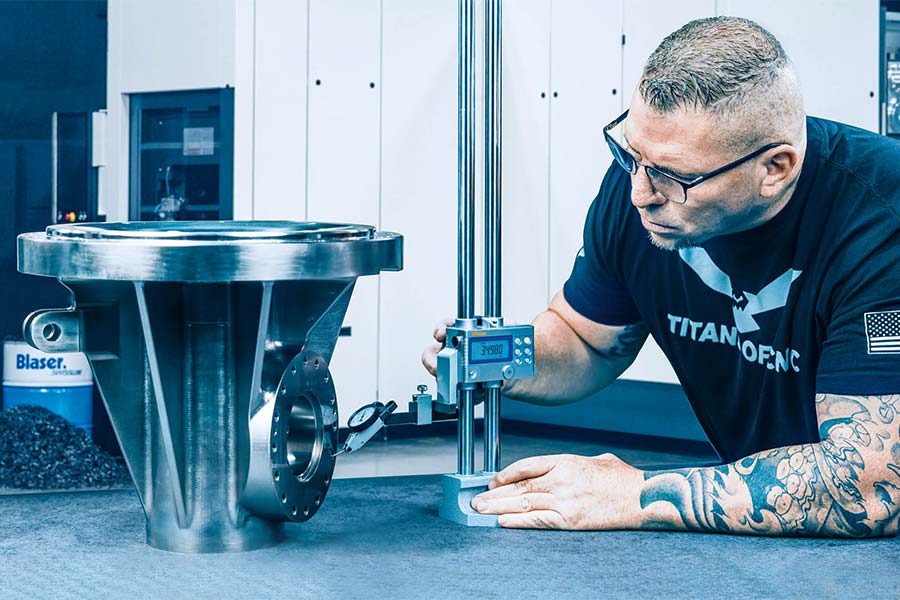
Titan Gilroy, founder and CEO of the US company TITANS of CNC, knows which factors influence process stability in machining. His online academy offers training to young professionals.
PROCESS AND PRODUCTION STABILITY IS ABSOLUTELY ESSENTIAL IN THE MACHINING INDUSTRY
In actual machining processes, stability depends on multiple factors that mesh seamlessly with one another. This always starts with the material used, since its properties determine how it can be processed. Hard materials, such as hardened steel or titanium, require the use of special tools and machines. The tool must be perfectly tailored to the material. This pertains to properties such as the cutting geometry, the material characteristics (e.g., carbide, CBN), and the coatings (e.g., PVD). On the machine itself, many crucial parameters for the process can be set, such as speed, feed rate, and cutting depth. The role that the metalworking fluid plays here should not be underestimated: it minimizes friction, cools the tool and the workpiece, and extends the service life of the cutting edges. This has a significant impact on the stability and efficiency of the production process.
Minimum quantity lubrication boosts productivity
Industry 4.0 also offers particular benefits for minimum quantity lubrication (MQL), which is mostly used in mass production. Given the narrow process window for the optimal production of parts that are often identical, the added value gained here from sensors and automated monitoring is significant. In this process of MQL, an oil and air mixture is used to create an aerosol that is sprayed as part of an automated process. This mixture leaves behind a protective film, which reduces friction and helps to prevent tool wear. Higher cutting speeds and feed rates ensure the “cooling” effect here. The compressed air, moistened surfaces, and evaporation also help to cool the cutting tool. MQL is ideally suited to processes such as highspeed cutting (HSC) or high-feed cutting (HFC). To ensure smooth operation, the processes must be very precisely tailored to the respective MQL application, which Industry 4.0 with digital process chains makes effortlessly possible. The benefits of MQL include lower energy consumption, cleanliness of both workpieces and chips, and good material compatibility.
Corporate stability and location stability
Another aspect of stability relates to corporate management: corporate stability refers to a company’s ability to provide its services consistently. This includes financial resilience and the ability to adapt to external changes (culture of innovation) – without losing sight of fundamental values. This requires clear strategic positioning as well as a balance between tried-and-tested processes (stability) and the ability to adapt to new circumstances (agility).
The ownership structures and location (political and social stability as well as infrastructure) can ensure stability and provide a competitive advantage. Furthermore, the factor of emotional stability should not be underestimated when it comes to corporate management. In times of crisis in particular, there is often talk about making adjustments to the strategy and making savings. Emotional stability, which can be a decisive factor when dealing with challenges, is often forgotten about. This is the ability of corporate management to create clarity for employees and the company as a whole and to foster confidence in uncertain times. Also this soft factor can be a basis for economic success.
Corporate social responsibility
Today, the aspect of corporate social responsibility (CSR) is also becoming increasingly important. This refers to the impact of entrepreneurial activity on society and the environment. CSR contributes to the longterm stability of companies by promoting trust, minimizing risks, and boosting efficiency. It covers aspects
such as working conditions (including health and safety protection), a commitment to the environment, prevention of corruption, fair competition, and transparency. By consistently implementing internationally recognized CSR criteria, companies contribute to sustainable development and help address societal challenges. At the same time, CSR can also have a positive long-term effect on competitiveness.
Stability at all levels
Stability is therefore a key factor that can result in a competitive advantage across all areas. This relates to economic, political, and societal criteria at the location, but also overall corporate stability, including with respect to finances, strategy, customer base, and supply chains. Process and production stability is absolutely essential in the machining industry, forming the foundations for a smooth production process and efficiency gains. Stable processes reduce the amount of rework required and minimize rejects and material waste, which in turn allows for cost reductions. At the same time, they help ensure adherence to agreed delivery dates. Thanks to consistent product quality, process stability has also a positive impact on the reliability of the company.