


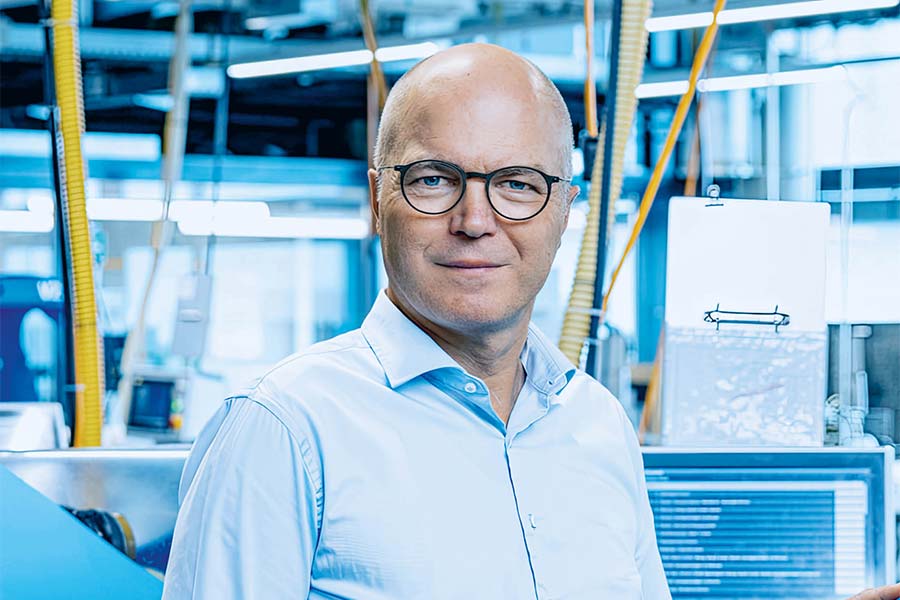
Interview Thorsten Kaletsch Photos Oliver Oettli
I think of Switzerland, as it is a very stable country. This is true both in terms of our political system and the economy and society as a whole. We have a high level of competitiveness, relatively low debt, and a robust financial position. This stability makes Switzerland attractive by international standards.
In terms of precision, quality and on-time delivery in mass production, we are considered the benchmark in our industry. In addition, our employee turnover is low, and we have many long-serving and experienced employees. Both factors have a lot to do with stability.
It starts with basic business principles. Financial independence and a
high degree of self-financing are key factors here: we only invest what we can afford. Those who have enough of their own funds during a Crisis are less likely to become dependent. What is more, we have always remained true to our core area of expertise: we have been producing watch screws for 180 years. How does that saying go again? Stick to what you are good at!
But Laubscher Präzision AG is also known for its innovations.
That’s true. That’s another factor that brings stability: it is all About striking a balance between Tradition and innovation. We have been manufacturing watch screws for 180 years – a seemingly simple product with a thread, a head, and a slot. Yet you could write entire books About our further developments and process innovations in this area, even over the past ten years alone! It is not a revolution, however, but more so an evolution, a continuous development. We also take care of all downstream work, so that we can cover the entire value chain in-house, all the way through to the ready-toinstall part.
Our museum in Täuffelen is home to a lathe that dates back to around 1870 and is probably the oldest working machine of its kind in Switzerland. Samuel Laubscher was involved in its development, as was Jakob Schweizer, another Inventor from the region, who gave his Name to the machine. It is no longer clear who worked on which parts, however. But what we do know is that lathes of this kind were in Operation in the factories run by Jakob Schweizer and Samuel Laubscher from 1876 onwards. The Swiss-type automatic lathe we know today had its origins in our region and with the involvement of our company founder. This is still referred to in English as the “Swiss-type turning machine” or “Swiss-type machining”.
Up until 1892, the slot had to be milled into the heads of the screws manually. One of the founder’s sons then developed a machine that allowed the screws to be manufactured in just one step for the very first time: a slot cutter was integrated into the machine, and a picking arm guided the turned screws to the milling machine. The Laubscher Brothers patented this design in 1892.

“WE HAVE ALWAYS REMAINED TRUE TO OUR CORE AREA OF EXPERTISE.”
It is still important: we supply Switzerland’s leading watch manufacturers – and for three of them, this has been the case for 140 years now. In addition to watch screws, we also manufacture other parts, such as spring housings or pins, and are constantly expanding on our production range by also taking on gear cutting work. This is crucial, since watch sales are in decline.
More than 50 percent of our Revenue is generated in the medtech industry. Here, for example, we produce parts for hearing aids, inhalation devices, or minimally invasive surgeries. Then there is also the industrial segment, which we supply with large quantities of complex small turned and milled parts. Taken together, these three segments give us stability. Since I joined the company at an operational level in 2012, there has only been one year in which These three segments developed in the same direction – every other year, there has always been one that has deviated: either two went up, and one down. Or two took a dive, while one gained ground. We often see a similar situation arise from a geographical perspective: our main markets are Switzerland, Germany and the USA – so three economic Areas with three different currencies.
Mass production is part of our DNA. From the very beginning, our company’s goal has been to industrialize production processes. And Quality has always been important to us as well. In the 1980s, we were one of the first industrial companies to gain ISO 9001 certification. Systematic test plans and statistical process controls help to ensure additional process stability. Our key success factors also include lean management and shop floor management. This enables us to implement daily Deviation management, which helps to ensure process security in a technical sense. Ultimately, however, our experienced, often long-serving employees are crucial when it Comes to stability.
Firstly, there is the material and ist tolerances: after a batch change, the set-up often needs to be adjusted, or tool wear is much greater. The tool, with its different materials, shapes, coatings, or clearance angles, is another influencing factor. This also applies to the machine itself and its mechanics. In addition, there are also various adjustable parameters, such as speed or feed rate. And finally, there is the metalworking fluid, which plays a central role in the interplay between the machine configuration, the tool and the material. It both cools and ensures a stable temperature – this means it influences all properties of the production process and makes it a key factor for process stability. You can get out a lot with the perfect tool. The same is true with the right metalworking fluid.
When it comes to metalworking fluid, you have been working together with Blaser Swisslube, another Swiss family business, for three Generations at this point. A machine from Laubscher was even recently installed in Blaser Swisslube’s technology center. What has this collaboration brought to your company?
The idea for this development collaboration arose during a dinner with CEO Marc Blaser. It concerned a contract of ours that runs for years with a high volume. We set up the machine in the technology Center in Hasle-Rüegsau the same way we would at our own facility, and a whole series of experiments and tests were carried out to help optimize the process. We were able to reduce wear and tear when sawing the material and gained insights into how to accelerate the production steps. Theoretically, we could have also optimized the lubrication solution – but our customer decided not to take the trouble to obtain approval for this.
Our company has been family-owned for 180 years, and in this time, it has always been managed by a member of the family. I am a CEO from the sixth generation, and the seventh generation of the family is already working within the company. We owe this stability to a structure that was established in 1919, back when the company was established as a public limited company: at that time, the four sons and the son-in-law, who was also named Laubscher, each received a 20 percent share – this division of power was enshrined in the articles of incorporation. Back then, at least three shareholders were always needed for decisions to be made; today, this figure is even higher, since the shares have become more fragmented. This meant that a single owner could never live off the capital alone, and profits were primarily reinvested into the company. The company, therefore, has always been – and will continue to be – the top priority.
The high costs force us to continuously optimize added value. This affects machine utilization, cycle time, work processes, and many other cost factors besides. That being said, Switzerland has a unique baseline and positioning in the production of small, highly precise parts, thanks to its watchmaking industry. This is something that can be harnessed when it comes to international business. The miniaturization trend in the medtech sector and other industries is working well for us. Despite all the technological developments in other areas, I am convinced that machining as a production process still has its place.
