

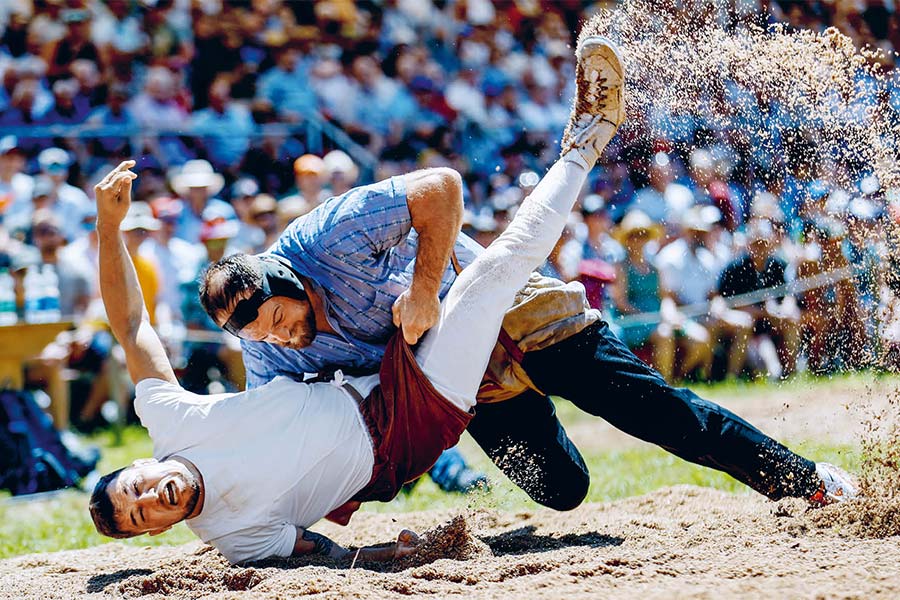
Matthias Aeschbacher, who stands 1.91 meters tall and weighs 120 kilograms, is known for his dynamism (pictured here celebrating victory at the Innerschweizer Wrestling festival)
Text Peter Bader Photos Barbara Loosli
Matthias Aeschbacher is one of Switzerland’s best Swiss wrestlers. His success depends on hard work and stability. Blaser Swisslube, as one of his sponsors, enables him to function as a top athlete. He has already celebrated several historic successes but is still working towards one particular dream.
He was a late bloomer and had plenty of nonsense in his head as a teenager, as his fellow Swiss wrestler, Patrick Schenk, recently recalled in an interview about their youth Training sessions together. In his younger years, there was nothing to indicate that Matthias Aeschbacher would one day become one of the country’s best Swiss wrestlers. Swiss Wrestling simply was not a top priority for him at the time. He still lacked the necessary ambition. “I had the same silly ideas as many other teenagers,” the 33-year-old recalls today. “I just couldn’t imagine going to wrestling practice five to six times a week.”
Then, in 2008, at the age of 16, he entered the Emmental Schwingfest (Swiss wrestling festival). Competitions in this form of Wrestling are referred to as “festivals” because they also celebrate the traditions of Swiss folk culture (see page 29). At that particular festival, he did not even come close to taking a winner’s wreath. The wreath, a headdress made from oak leaves, has great significance for the athletes: only the top 15 to 18 percent of Swiss wrestlers in the final ranking will win one at a competition. This bothered young Matthias Aeschbacher, especially since his friends succeeded in taking a wreath home. That, he recalls, is when things “clicked” for him.
Your content goes here. Edit or remove this text inline or in the module Content settings. You can also style every aspect of this content in the module Design settings and even apply custom CSS to this text in the module Advanced settings.
Matthias Aeschbacher grew up on a farm in Heimisbach in the Emmental region with three brothers: one younger and two older.Both of his older brothers were Swiss wrestlers, and so it was almost inevitable that he would also end up in the wrestling hall. Although his Passion for the sport was not particularly great, the fact is it would have been “impractical” for the family to have to attend football matches in addition to wrestling festivals. But to this day, Matthias Aeschbacher loves the popular traditions associated with the sport, and he has met many like-minded people through Swiss wrestling. “All are welcome here, no one is excluded,” he emphasizes.
After school, he completed an apprenticeship as a bricklayer and attended wrestling training once or twice a week. But even so: until that Sunday in 2008 when he missed out on a wreath, he did not have any real ambition. Then he said to himself: “If my friends can do it, I can do it too.”
He ramped up his training and reaped the benefits of his ideal physical attributes: today, he measures 1.91 meters and weighs 120 kilograms. Abandoning the follies of youth, he gained qualities that have made him successful to this day: “I am hardworking, serious-minded, and consistent.” The first successes came quickly: he won his first wreath at 19, and four years later he won his first Wrestling festival in the Bernese Oberland.
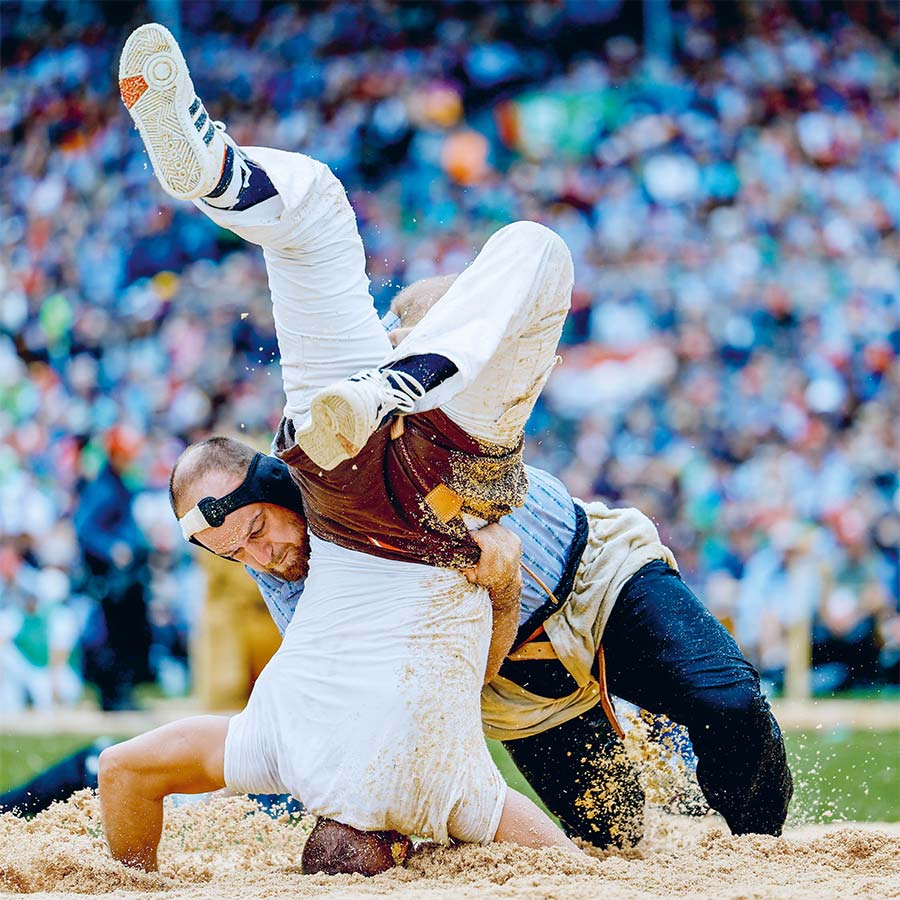
Matthias Aeschbacher (here in the blue shirt) is one of Switzerland’s best Swiss wrestlers. Shown here winning a bout at the Eidgenössisches Schwing- und Älplerfest (Swiss Federal Wrestling and Alpine Festival) in Mollis in 2025
CONSISTENCY AND STABILITY ARE DECISIVE FACTORS IN HIS SUCCESS.
His career has continued to go from strength to strength: to date, he has won 16 major Swiss wrestling festivals. In 2025, he became only the 34th wrestler in the history of the sport to win his 100th wreath. What he has not yet achieved is a victory at a national Swiss Wrestling festival, where the best wrestlers in the country come together to compete. Examples include the two-day Eidgenössisches Schwingund Älplerfest (Swiss Federal Wrestling and Alpine Festival), which is held every three years to determine the “Wrestling King”, the most coveted of titles. Matthias Aeschbacher came very close to achieving this, only failing in the final round against Joel Wicki, the king for that year, in 2022. At any rate, he won a wreath at three such national wrestling festivals, which earned him a reputation as a respected “Böser” (bad guy), as these wreath winners are called.
A sense of certain victory
Consistency and stability – that is, stability in the literal sense – are decisive factors in his success. He has only missed out on winning a wreath at three wrestling festivals since 2016. His robust physical fitness and stable Health are a particular help. In his career to date, he has only ever had to take breaks totalling around two months due to injuries, and he has never missed a competition. “It helps that I take a two-month break after each season to fully recover,” Matthias Aeschbacher explains. Furthermore, he does not take risks when wrestling: “If I fall, I fall; I don’t try to wriggle out of it. And I avoid using throws that can easily twist your knee. But of course, I’ve also had my share of luck in my career.”
There is one thing he particularly appreciates about competing: “If I realize over the course of the fight that I’m going to win, that’s a really cool feeling.” However, appearances can sometimes be deceiving, as was the case in the fifth bout at the Swiss Federal Wrestling and Alpine Festival in August 2025 in the canton of Glarus: “After two attacks, I thought: Now I have him. The next Moment I was lying in the sawdust.” And so, he had to shelve his dream of earning the title of king once again. In the end, he came in fourth and took home a solar energy system as his prize. This will be installed on the roof of his home, the construction of which will begin in Hasle-Rüegsau in the fall of 2026. From their current apartment, the Aeschbacher family have an unimpeded view of their new property.
Matthias Aeschbacher is now able to make a decent living from Swiss wrestling. From August to November, he is employed full-time as a bricklayer and foreman at the same Company where he completed his apprenticeship. For the rest of the year, he only works 40 percent of a full-time schedule. “I’m a semi-professional,” he explains. The only way he can afford to do this is thanks to numerous sponsors, including Blaser Swisslube, a company based in his home region. “This creates a very special bond and feeling of identity.”
The next Swiss Federal Wrestling and Alpine Festival will be held in Thun in 2028. He is planning to take part in this one as well. The dream of a national title lives on. Whatever happens, the Aeschbacher name could continue to be part of Swiss wrestling for even longer since his five-year-old son Nino is already enthusiastically attending Swiss wrestling Training sessions. “He has good physical attributes,” says Matthias Aeschbacher. “But the most important thing should be that he enjoys it. Everything else is still a long way off.” Who knows though – maybe he too will end up causing a stir on the sawdust. From the sounds of things, he is probably unlikely to be a late bloomer like his dad.
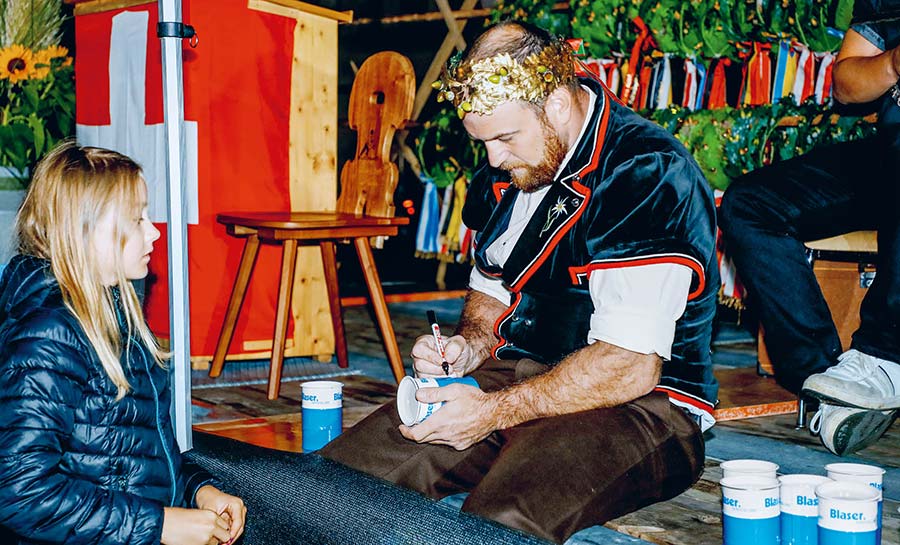
As one of his sponsors, Blaser Swisslube enables Matthias Aeschbacher to be semi-professional
Swiss Wrestling requires stability
Swiss wrestling is known locally as “Schwingen” and is a variant of freestyle wrestling. This traditional sport is practiced by both men and women, and almost exclusively in Switzerland. The bouts are fought without weight classes in a ring covered in sawdust. Using various moves, the opponents try to throw each other off balance and onto their backs. They hold onto one another by a leather belt and a pair of jute breeches. Thus, both balance and physical stability are particularly important for success in Swiss wrestling. For wins, draws and losses, between 8.5 and 10 Points are awarded per fight. The two leaders in the ranking list compete in the final bout – the last fight of the Swiss wrestling festival – and determine the winner between themselves.
A look back at Matthias Aeschbacher’s career highlights
2011
“No time to celebrate”
“I won my first wreath at the Emmental wrestling Festival in 2011. The festival was held on a Sunday and my final apprenticeship exam as a bricklayer began on Monday morning. Hence, I wasn’t really able to celebrate my first success properly.”
2016
“I learned a lot from my defeats”
“I had had a very successful year, with nine wreaths won. So, I firmly believed that I would win my first Swiss federal wrestling wreath at my second Swiss Federal Wrestling and Alpine Festival. I missed out on Victory and was bitterly disappointed. The experience taught me that I need to work even harder if I want to achieve major success.”
2019
“The key to acceptance”
“At the Swiss Federal Wrestling and Alpine Festival in Zug, I finally won my first Swiss federal wreath. To gain sporting acceptance among Swiss wrestlers, such a wreath is more important than coming out on top at a smaller wrestling festival.”
2022
“I was able to handle defeat”
“At the Swiss Federal Wrestling and Alpine Festival in Pratteln, I was in the final round against Joel Wicki and had a chance of taking the wrestling king title. It was a back-and-forth affair and I had a few opportunities to win. Yet, I still lost. But, because I had given it my all, I was able to handle this defeat. Although, of course, as a Swiss wrestling king, you move into an entirely different league, also financially speaking.”
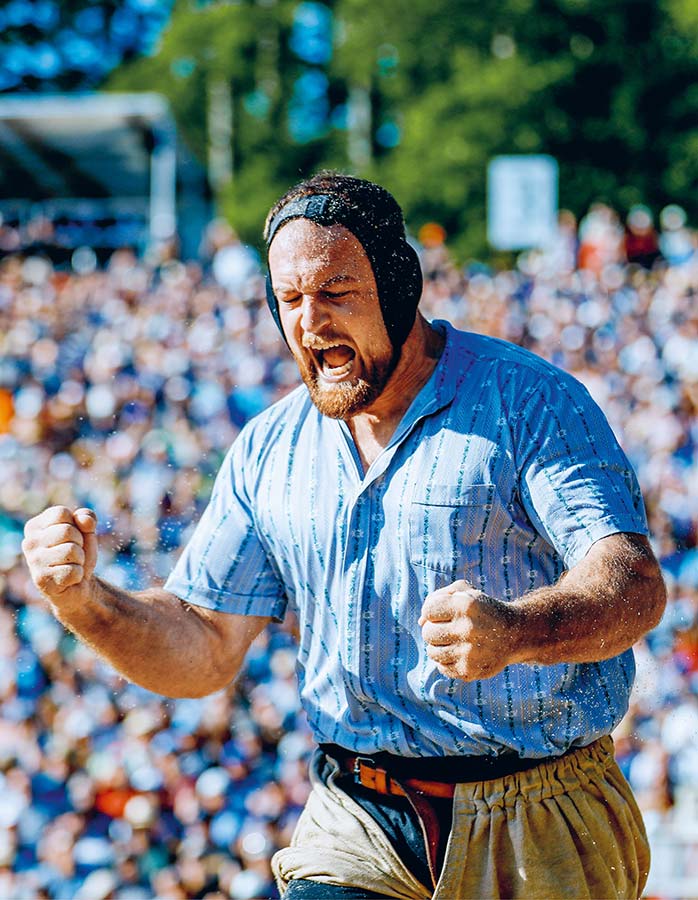
Matthias Aeschbacher has already celebrated winning a wreath over 100 times in his career