


Text Manuel Schläppi
“The short answer: by carefully selecting the product and with professional handling and care. As a comparison, think of a large ship. This requires a responsible captain at the helm who will make slight Adjustments to ensure the ship stays on course. If a deviation is not noticed in time, costly maneuvers will be required later on in order to correct it. The exact same principle applies to metalworking fluids.
A stable metalworking fluid brings several benefits. First, machine downtime can be avoided, while simultaneously ensuring a consistently high degree of quality for the parts produced (e.g., surface quality). This has a positive impact on productivity as well as budget. Second, employee satisfaction increases, since the metalworking fluid retains a pleasant and neutral odor. Third, the Environment also benefits, since a long service life has a significant positive impact on the ecological footprint.
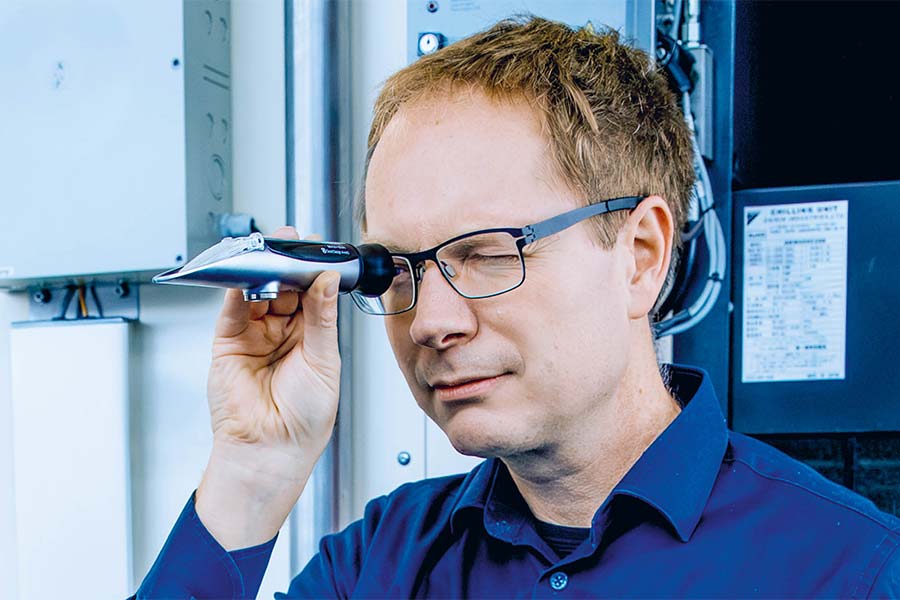
Product – skilled workers – services: these are the three deciding factors. When selecting the product, all the specifics have to be taken into account. The materials, regulatory requirements, upstream and downstream processes, as well as water quality play a major role here, and the metalworking fluid must be ideally suited to all these elements. Handling and maintenance require dedicated employees on site who are motivated to take care of the metalworking fluid. Monitoring focuses primarily on concentration and pH value, which can be measured quickly and easily. A look through the refractometer provides information About the concentration while also giving a visual indication of any contaminants. The pH value is determined using conventional pH test strips. For larger systems, it is also recommended that samples are sent regularly to a laboratory to monitor factors such as salt content. Automated and digitalized solutions also make a valuable contribution to ensuring that the metalworking fluid remains stable. They continuously monitor ist condition and regularly refill it with the correct amount at the desired concentration.”
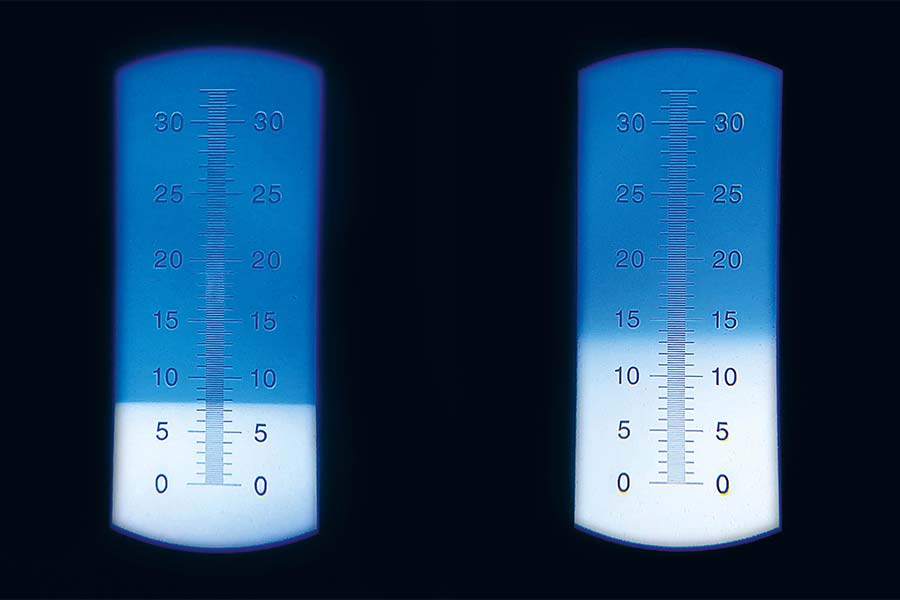
A look through the refractometer shows clean metalworking fluid on the left and contaminated metalworking fluid on the right.

Manuel Schläppi, Global Head of Chemical Sales Support, Blaser Swisslube
Ph.D. in Chemistry