


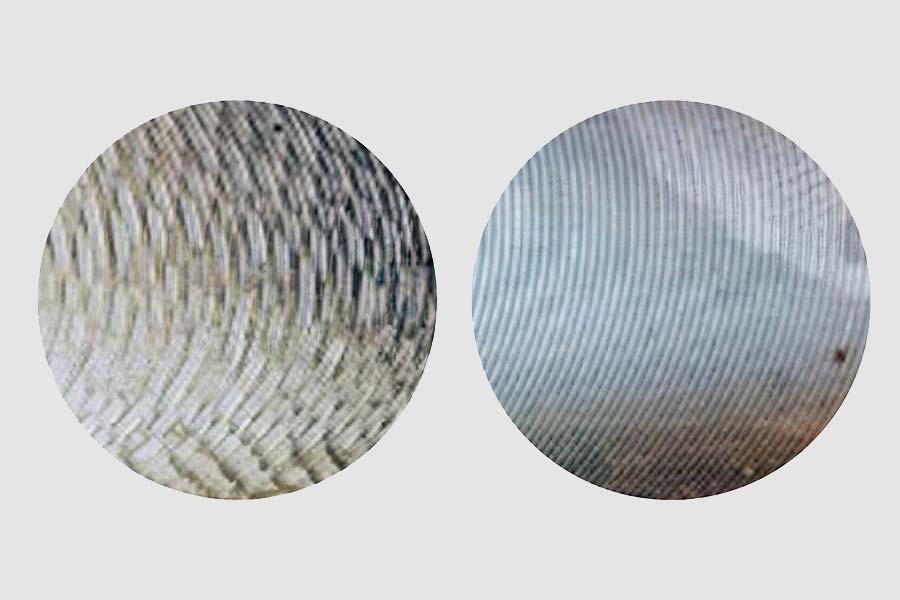
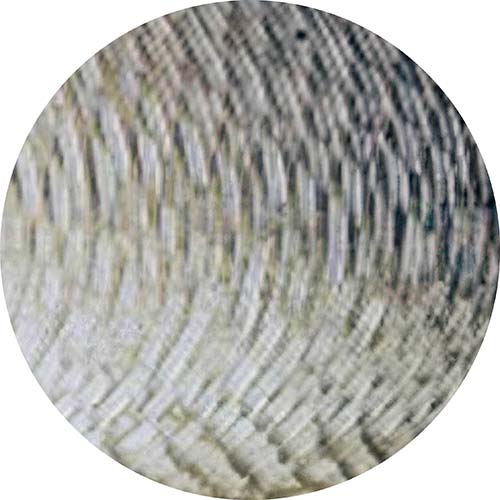
The problem is a well-known one: a phenomenon known as chatter can occur in many machining processes. These self-excited vibrations sometimes exhibit high amplitudes and can lead to poor surface quality and a significant reduction in tool life. They can even result in damage to the workpiece or the machine. Finding the cause and improving the Situation takes time. And the new Parameters that can eliminate chatter often lead to reduced productivity.
Interaction between various factors
These vibrations are self-excited, which means they do not result from external stimuli, but rather arise from the interaction between the machine, the tool, the workpiece, and the clamping device. The workpiece surface plays a central role here, “storing” the vibrations of the preceding tool cutting edge and exciting the next cutting edge after a period of downtime with the vibrations of the preceding cutting edge.
Making changes to production parameters, such as the cutting depth, feed rate, or main spindle speed, can help to reduce chatter. The Major challenge here is evaluating and defining these changes while also taking into account maximum productivity and economic efficiency. Furthermore, for a variety of reasons, such changes are often not permissible. Then, in addition to changing the process parameters, modifications will often also need to be made to the tool, clamping device, or even the machine.
Finding optimal solutions to combat chatter in many individual machining processes is always a scientific challenge. Much research has been conducted worldwide on this topic in recent decades. Robust and cost-effective solutions that are suitable for all industrial combinations of machines, holding devices, and tools have not yet been developed.
For a new approach to solving this issue, the Swiss technology Transfer institute inspire AG and the Institute for Machine Tools and Manufacturing (IWF) at ETH Zurich have joined forces with implementation partners from the Swiss manufacturing industry. The solution uses a combination of physical models and artificial intelligence techniques. It relies on a cost-effective system that monitors process noise and taps into potential discrepancies between the model prediction and the actual process state. This approach is superior to traditional modeling in terms of predictive accuracy and to purely data-driven machine learning in terms of data efficiency.
The Fraunhofer IWU in Chemnitz uses an integrative Approach made up of simulations and fast measuring techniques that can be used on site. The analysis begins with Vibration measurement while machining is taking place in order to locate the chatter frequencies. Then, the dynamic stiffness is measured. Both measurements can be performed relatively quickly and provide the necessary input data for subsequent calculations. Flaws can already be identified at this stage, and the calculations make it possible to assess the effectiveness of possible measures to combat the chatter. If necessary, an experimental modal Analysis is then carried out to more precisely pinpoint design flaws within the machine. However, this is not only more time-consuming but also involves on-site measurement, which takes around a day to carry out.

Interested companies can book this research activity as a service. The Fraunhofer IWU always Looks for solutions that fit the client since not all theoretically conceivable measures can be readily implemented for the respective company. Another option would be to provide the Client with a suitable calculation tool in the form of an app and Train them in how to use it so that they are able to eliminate the chatter in their production themselves.
Dr. Martin Kolouch, specialist in machine analysis at Fraunhofer IWU, emphasizes: “With our approach, we found that the production parameters that determine productivity are already a very good fit in some cases.” Optimizations are possible, especially in workpiece clamping, as the project shows: “There is significant potential for improvement here.”