


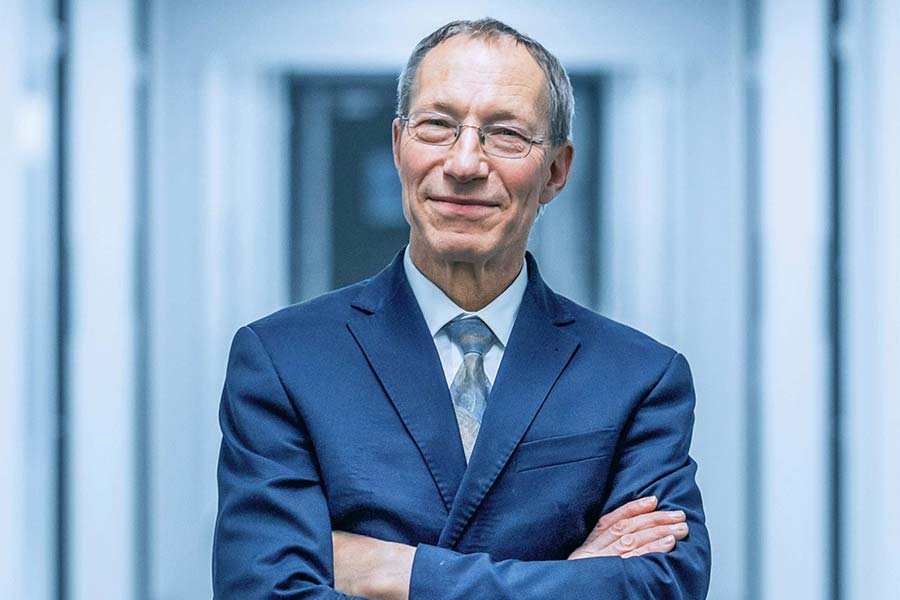
The center of excellence for transferring technology, inspire AG, in Zurich, serves as a functional interface between the world of research and the mechanical, electrical, and metal industries. Senior advisor Konrad Wegener speaks here in an interview about innovation,responsible resource management, and the opportunities presented by artificial intelligence in the machining industry.
Mr. Wegener, what first comes into your mind when you hear the word innovation?
For me, innovation refers to new ideas or technologies that are then implemented commercially. The more profound the innovation, the longer its path to implementation. This therefore requires a certain Degree of perseverance. You can’t simply innovate one day and then sit and do nothing for a year. Innovation is an ongoing process.
The market is constantly evolving. To remain competitive, the process of innovation must be practiced on a regular basis. To give you just one example: I previously worked for a press manufacturer. The most decisive competitive factor here was speed. Behind the scenes, we were always secretly preparing for the next generation of presses, and as soon as anyone brought a new, more powerful press to market, we were already one step ahead in our development.
The most important factor is the exchange of ideas between experts from different fields, including science and industry, for example. That is precisely why conferences are so valuable. Innovation requires an openness to other ideas – and a willingness to share your own. In Switzerland, we unfortunately tend to have a habit of keeping everything fairly tightly under wraps.
Speaking of innovation: What are the next major developments coming to the machining industry?
The industry will undoubtedly see significant developments in the Areas of AI, automation, intelligent machines, and additive manufacturing. In my opinion, the issue of raw materials is currently receiving far too little attention, because, unlike energy, these resources cannot be replenished. For example, toys containing high-performance Magnets are now ending up in the scrap heap. The dysprosium contained within these is then lost forever. To reuse valuable raw materials, they must be returned in a pure, properly sorted form. At the same time, this leads to higher costs. This is a factor that needs to be carefully considered. If we continue to exploit our planet the way we are now, critical raw materials will be depleted within the next 100 to 150 years. And what happens then?
Significant developments can be expected in this area. Ceramics are the rising stars on the horizon here. They are still too brittle for now, but the progress made could make them a viable future alternative to tungsten carbide in tools. Diamond tools also offer significant potential, through the application of laser processing. However, it will not be enough to simply replace one material with another. The entire System will need to be rethought from the ground up. And this also applies to the way we handle the reuse of raw materials, for example. Cutting and machining tools produced from hard metals and high-speed steels contain valuable raw materialssuch as tungsten and cobalt. Only a very small part of the tool – namely the cutting edge – is actually worn down. Instances like this are where recycling at the highest level becomes possible, specifically in the form of a product in its own right. Generally speaking: When we know exactly what a material is made of, this allows us to recycle a larger portion of the raw materials after use and keep them in circulation. Another key point to consider is reliability. In mass production, tools are typically replaced after a certain number of units have been produced, although some of These may still be functional. Which is why we are also researching ways to predict tool life more reliably – and in doing so, get more life out of our tools before retiring them.
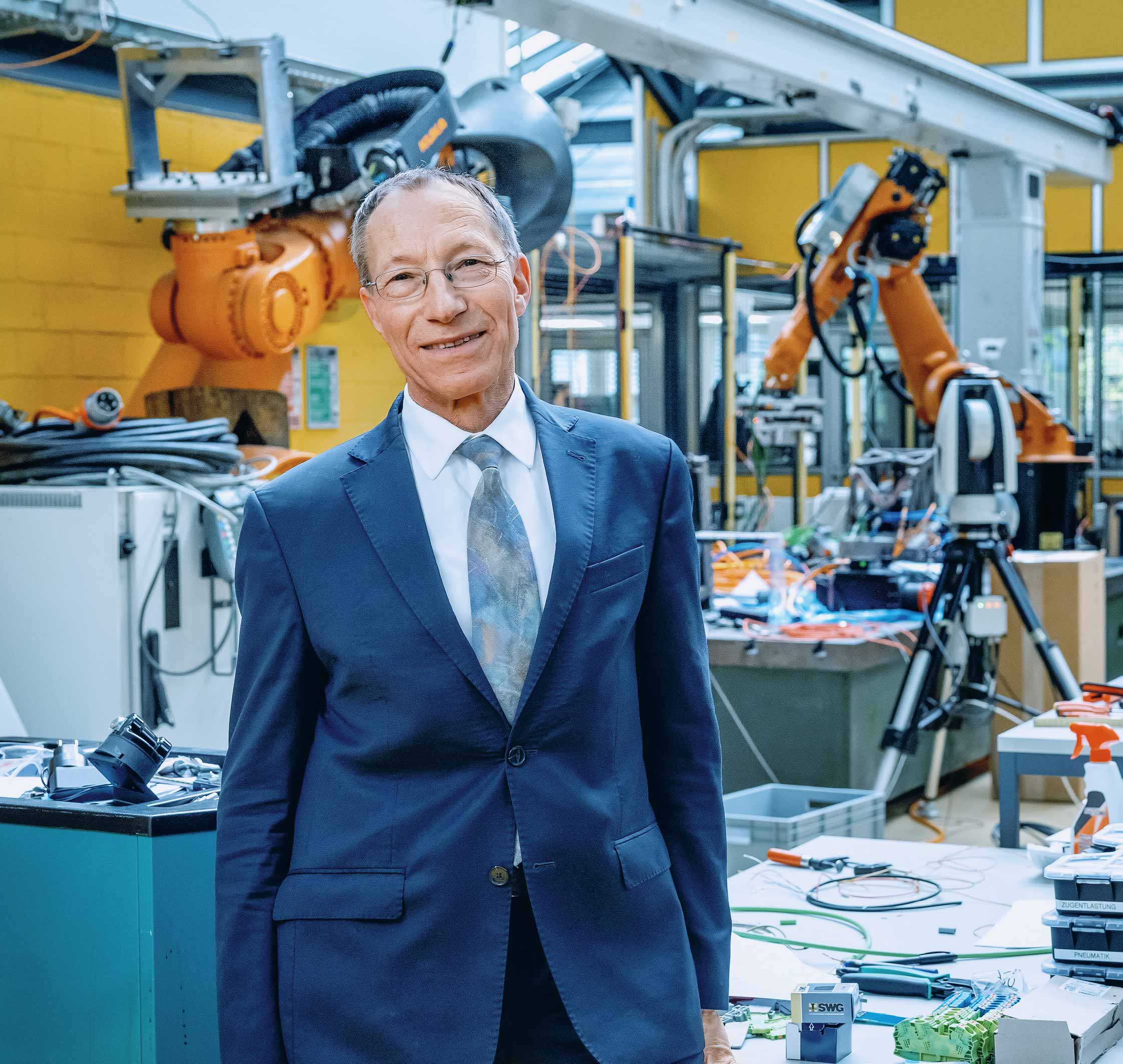
“INNOVATION REQUIRES AN OPENNESS TO OTHER IDEAS – AND A WILLINGNESS TO SHARE YOUR OWN.”
We should always be sure to look at the system as a whole. The long-disputed matter of the metalworking fluid also has a key role to play here. One approach would be to reduce its use. But if we omit it entirely, tool wear increases – which, if we want to save tungsten and cobalt at the same time, is rather counterproductive. Furthermore, thermal compensation represents another means of reducing overall climate control requirements. And by reducing machine and process times while increasing machine run times, the embodied energy can be utilized more effectively. Collectively, these measures also result in lower costs overall.
advances in this field have on the industry?
AI is currently still in its infancy. But it will fundamentally alter the way in which humans and machines work together. Production processes are complex – and this is not about to change. But it is up to us to decide whether this complexity will lie with the operator or with the machine in the future. I see great potential for innovation in the machine tool industry here, namely by transferring complexity to the machine. The machine tool of the future will be self monitoring and capable of making the right decisions with the help of AI.
From my perspective, the importance of additive manufacturing is often overstated. For the production of individual parts, it certainly offers attractive advantages. But the process of machining cannot simply be replaced. Anyone who manages to achieve a two-percent increase in productivity in machining today will have achieved, thanks to the enormous leverage involved, more globally than anything that has been achieved thus far in the field of additive manufacturing.
We maintain international contacts in production engineering Research and apply their know-how to specific industrial projects. Alongside this, we conduct dedicated in-house research aimed at developing and expanding our own expertise. The most significant challenge lies in putting this into practice on an industrial scale. Much can be achieved in laboratory set-ups, but under real production conditions, things can become challenging – particularly when processes are required to work well in mass production or when Chips and metalworking fluids come into play and may complicate matters.
What matters most is a willingness to work together with the research institution. If individual small and medium-sized machine tool companies each try to develop independently in areas such as Industry 4.0, Operator assistance systems, and AI, their progress will inevitably be far too slow when compared with larger companies. In these areas, many decisions are made long before companies start competing with one another. My hope is that inspire will take on the role of a research and development department for the entire Swiss machine tool industry. This means that we will use basic Funding from the federal government, subsidies, and company contributions to conduct research, the results of which will then go on to benefit industry as a whole.
Yes, there are several. As part of an EU project, we have succeeded for the first time worldwide in producing helical tools made of fully polycrystalline diamond, using an ultrashort pulsed laser. Since inspire was first founded, we have also been working on the thermal compensation of machine tools. Previously, the requirement for a machine tool was high positional accuracy. Today, the most important factor is repeatability. At this point, we can now compensate for around 80 percent of the errors that occur on the machine tool. Another project line that’s particularly exciting is chatter suppression. While thermal compensation is already being used successfully in industry, chatter suppression is still a work in progress, owing to the multitude of influencing factors that are difficult to capture.
When you look toward the future, what do you think the greatest challenge will be for machining?
We are sure to see challenges in the area of AI and where humans and machines are working together. Furthermore, in the manufacturing industry, and thus also in the machining industry, pressure from administrative and at times bureaucratic regulations is increasing, which stifles innovation in the actual area of expertise. Another factor to consider is the race against China. This is not a race we can win through innovation alone. I once worked for a manufacturer of wafer saws, which are high-precision special machines used in the production of semiconductors. We developed a saw that outperformed all others, and half a year later you could buy the same machine from Chinese manufacturers for half the price. We ended up having to halt production as a result. The reason for this was not bad management, but rather simply the fact that China has a different economic policy than we do: The Government has a goal and a plan, and if it wants a particular technology, money is no object. In contrast, we have more of a laissez-faire mentality. We will only be able to win this race if our politicians also Champion new technologies.
And given all these challenges, what is your outlook for the future?
I am an optimist by nature. It is essential that Switzerland remains competitive. It is not only politicians that have a role to play here, but also the industry itself. Regarding training, for example: How is a young person supposed to think about a career in the machining Industry when they regularly come across cars and airplanes in public, but not machine tools? We therefore need to create more visibility.
