


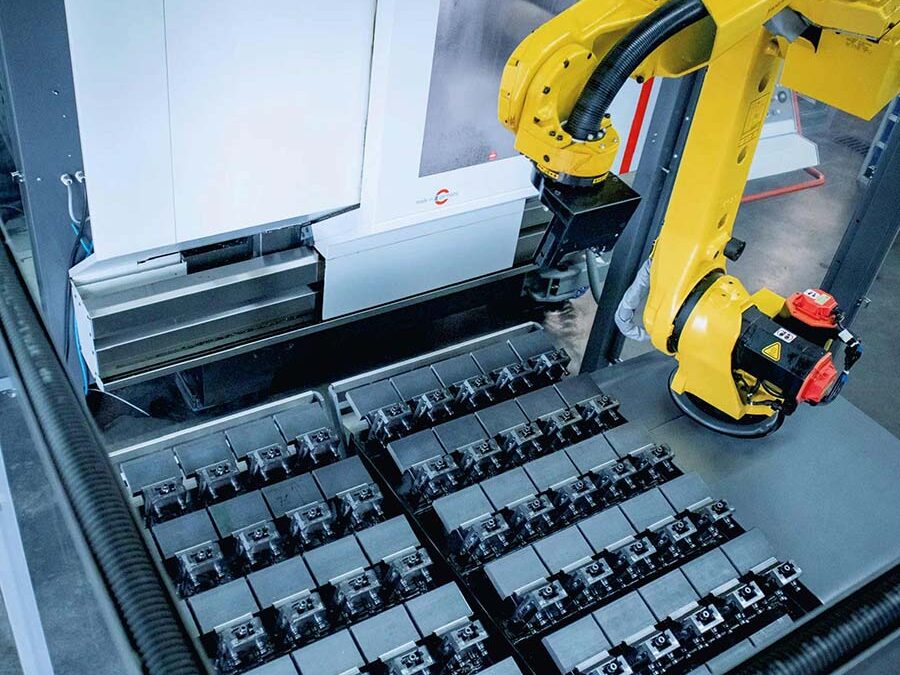
Innovative vise-handling system: In the RoboTrex Automation solution, the vise is picked up directly by the robot. (LANG Technik GmbH)
Text Denise Fricker Photos provided
Automation and digitalization have become the driving forces behind the machining industry. Where an operator once monitored tools, today it is sensors that take on this role. The goal is to optimize efficiency and, by extension, productivity. And yet, the data collected still holds untapped potential.
For businesses, innovation is a key pillar that allows them to remain competitive in the market. Just as the name suggests, it is all about creating something new. It is derived from the Latin verb “innovare”, meaning “to introduce something new”. ISO standard 56000 (Innovation Management) defines innovation as “a new or changed entity, realizing or redistributing value”. But what is it about innovation exactly that makes it so important? Innovation is a decisive factor for companies’ growth and long-term success, since it helps them to adapt to market changes, optimize their efficiency, stand out from the competition, or respond to new customer needs.
Exploring ideas freely and without constraints is a fundamental requirement for innovation. It takes people who can think outside the box to come up with ideas in the first place. “An idea becomes an Innovation only once it can be brought to market. Up to that point, failures and unfavorable results should be considered a natural and integral part of the research process,” notes Dr. Olivia Bossart, Head of Innovation at Blaser Swisslube.
But what does innovation mean for the machining industry? The role in machining is clearly defined: a component must be produced at a set volume, using a given material and within predefined tolerances – with the goal of making this process as economical as possible. “We have found the most effective way to do so is with automation, intelligent sensor technology, and consistent process monitoring,” says Dr. Linus Meier, Process Engineering Team Lead at Blaser Swisslube. Olivia Bossart sees things the same way: “Alongside other benefits, Automation allows for an increase in speed, which in turn boosts productivity. It also frees up experts to Focus on those aspects that automated systems are unable to handle.”
Some of the most standout innovations in the machining Industry include collaborative robots – or cobots for short. These work alongside humans, taking on repetitive Tasks such as the loading and unloading of workpieces. This eases the burden on skilled workers, allowing them to devote their time to tasks that make full use of their expertise. Cobots are already well established in the machining industry. As is pallet Automation – another key driver of Efficiency gains. New machines are rarely supplied without it anymore. Workpieces are set up in the clamping device outside of the machine, allowing the machine to continue to run uninterrupted.
According to Linus Meier, smart machines and tools equipped with sensors play a prominent role in research. These rank among some of the most promising innovations. Sensors are integral to process monitoring. They measure virtually all physical parameters relevant to machining: cutting forces, temperature, sound, vibrations, as well as Parameters relating to metalworking fluid. They make this data available in real time and transfer it into the process monitoring system.

A sensor-equipped tool holder that measures process forces such as bending moments, torque and axial forces. (pro-micron GmbH)
“WE DELIVER THE GREATEST IMPACT THROUGH AUTOMATION, SMART SENSOR TECHNOLOGY, AND CONTINUOUS PROCESS MONITORING.”
Dr. Linus Meier, Head of Team Process Engineering at Blaser Swisslube
Integrated systems are closely networked with the machine and record the measured values. These systems can then detect whether the signals they receive are within the normal range. “Previously, operations depended largely on the operator’s experience and expertise,” Linus Meier points out. The operator relied on sound to tell whether a tool was operating properly. When components are processed in high volumes and with a high degree of automation, however, the system runs unattended – and this calls for a reliable source of information.
One application that is already established on the market is intelligent tool holders. Manufacturers such as Rego-Fix (see report starting on page 18) already offer holders with a built-in vibration sensor that provides insight into the tool’s condition. This makes it possible to monitor wear and tear, for example, so that the tool can be changed precisely at the moment it becomes necessary.
The benefits of this are clear: Improved service life means lower tool costs. Process security likewise increases, since any issues are detected before they lead to any losses, which ultimately optimizes the entire process. Fully plug-and-play solutions are not yet being offered, however. Intelligent tool holders and process Monitoring systems, on the other hand, are already available on the market. But meaningfully integrating These systems into one’s own processes still calls for plenty of know-how.
Just like many other industries, the machining industry is also conducting extensive research into the integration of artificial intelligence (AI). “In machining, use of AI is still trailing far behind when compared with mainstream, everyday applications,” Linus Meier explains. The amount of publicly available machining data is reportedly limited, since machining companies keep this data secret, viewing it as a key competitive asset. “And this limited amount of process data does not provide enough material to support the Training of a machining-related AI model.” Several universities, including ETH Zurich, are researching how it might be possible to combine physics-based models with data-driven approaches. The goal is to impose strict limits on AI: It is intended to step in and optimize processes in areas where interdependencies become too complex for human operators to follow. On the other hand, there is no need for AI to reinvent physical principles that are already well understood.
In theory, AI offers the potential to optimize all of the tool and process parameters across machining, including with respect to metalworking fluid management. Maintaining the metalworking fluid by regularly monitoring parameters such as concentration means fewer machine failures and – thanks to the detection of deviations at an early stage – less wear on the tool, too. Liquidtool Systems provides support here with its intelligent metalworking fluid Management system. The plug-and-play solution automatically monitors the condition of metalworking fluids. Regular measurement forms the basis for stabilizing and optimizing processes, increasing efficiency, and identifying problems at an early stage. Intelligent metalworking fluid Management can reduce metalworking fluid consumption by up to 40 percent.
Additive manufacturing:an overrated innovation?
As with many innovations, new applications usually do not replace or displace existing solutions. Rather, they complement them. This also applies to the increasing number of options available in the field of additive manufacturing (3D printing). The focus of research currently is on how additively manufactured components are machined, and whether these behave differently than conventionally manufactured materials. An aluminum component made from powder using a process of selective laser melting is, at least on paper, identical to a cast component. However, its microstructure is fundamentally different – which in turn affects its machining behavior. Whether or not additive manufacturing will make it in the future possible to do away with machining steps such as finishing is still unclear. Since, in practice, it is rarely possible to produce an additively manufactured part so precisely that no further machining is necessary.
Digitalization, automation, and AI all generate data. Where this data ends up being stored is partly determined by the amount of data generated. The current trend is clearly shifting toward cloud-based data storage solutions. But the machining industry is proceeding with caution: Who will be able to access this data? What would happen if it were to fall into the wrong hands? Beyond how the data is stored, the other challenge lies in how it is used.
Although there is a lot of data already being collected within the machining industry, this has so far led to only very limited insights for process optimization. Olivia Bossart sees considerable potential here. “Data communication cannot be automated that quickly,” she says. Doing so, would require, among other things, having the right mix of people on the team: an experienced machining technician, a programmer, and someone who can interpret the data and draw the Right conclusions from it. “A key part of innovation also involves communicating it outward,” says Bossart. An Excel spreadsheet containing the raw sensor data might work well for one person, she explains, while someone else might need to be given more information. “Data needs to be tailored to the recipient for it to be effective.”