


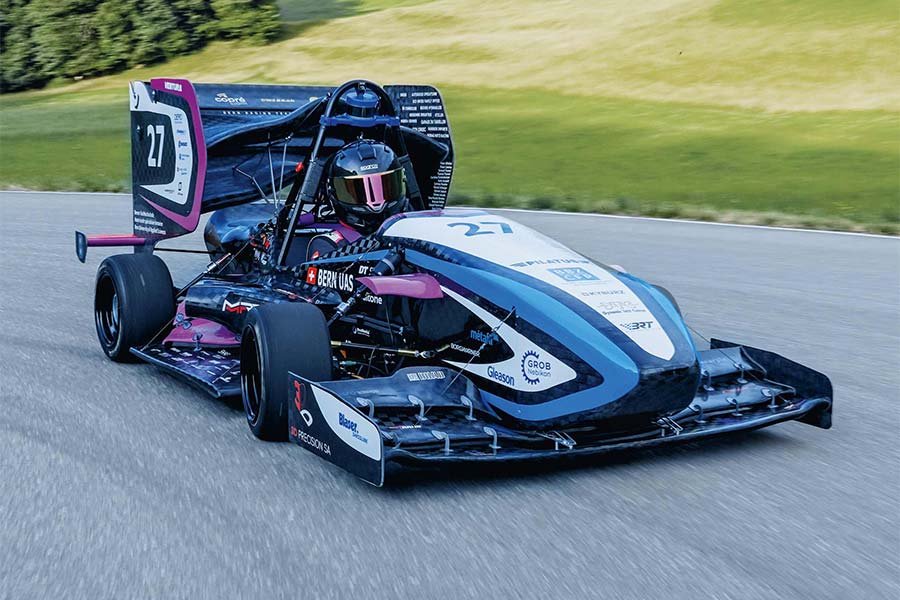
The electric race car VENTURA at full speed: The Bern Racing Team competes against universities from around the world in Formula Student competitions.
Each year, the Bern Racing Team at Bern University of Applied Sciences (BFH) draws on the latest Technology to build an electric vehicle within nine months that it then uses to take part in the Formula Student racing series. For the 2026 season, the team decided to break with tradition and embrace innovation. Blaser Swisslube’s expertise made it possible to manufacture the wheel suspension with a high degree of precision.
Collaborating on the development of an innovative vehicle and taking on an active role within a professional racing team? That’s the dream of many young car enthusiasts and aspiring automotive engineers. And the members of the Bern Racing Team are making this dream a reality. As automotive Engineering students at BFH, they work together to develop an electric racing car every year. A Vehicle equipped with state-of-the-art Technology comes together in just nine short months. The goal? Success in Formula Student races, competing against other universities fromaround the world.
The groundwork for today’s Bern Racing Team was established by two students back in 2014. After their exchange year in Germany, they returned with the vision of forming a Formula Student team. At the BFH School of Engineering and Computer Science (BFH-TI), students should also be able to participate in the planning and implementation of a race car from start to finish – just like in a real racing team. Following a restructuring in 2022 – and thanks to the support provided by Industry partners and sponsors, the BFH-TI, as well as numerous alumni – the newly professionalized organization was already proving successful as early as 2023: With its vehicle known as NEBULA, the Bern Racing Team made it into the Top 50 in the Formula Student World Ranking list for the first time, ranking 49th from among the 448 teams listed worldwide.
With passion and commitment
The Automotive Engineering Degree program is currently the only full-time study program at the BFH-TI and requires a high level of in-person attendance. Yet, it is precisely these students who are ideally suited for involvement in the Bern Racing Team.
In the first year, they can get a feel for what it’s like to be part of a racing team. To start off with, they are initially assigned smaller, lowerresponsibility tasks. The team members in their second or third year of study then invest between 1,000 and 2,000 project hours per year in design, measurement, development, production, and project management. Only under these conditions can it be ensured that the vehicle will be ready for the racetrack in nine months.
This workload is comparable to that of a fulltime job alongside the degree program itself. And then there are the trips to racing events, sponsor events, and technology and educational trade fairs. Those who want to be involved must be prepared to make certain sacrifices and have a genuine, driving passion for cars. But the atmosphere is also very close-knit and familylike, says Edi Nawrocki, Head of Suspension for the Bern Racing Team. The team’s members inevitably spend a lot of time together, and not just in the workshop, but also as part of the degree program at the university.

Precision down to one hundredth of a millimeter: The VENTURA wheel carrier was produced using additive manufacturing and subsequently finish-machined to extremely tight tolerances.
“SURFACE QUALITY AND DIMENSIONAL ACCURACY ARE ABSOLUTELY CRITICAL FOR THE WHEEL CARRIERS.”
“The team’s devotion and drive really is the best kind of publicity for this study program,” says Melanie Nellen, Automotive Engineering Project Manager at the BFH-TI. “Many People don’t even realize that it is possible to study Automotive Engineering in Switzerland. And they become even more enthusiastic About this possibility when they realize that by doing so, they can also play a role as part of the Bern Racing Team. The BFH-TI Benefits enormously from this high-impact appeal.”
The Bern Racing Team is organized just like a company. Its management consists of a CEO, a CFO, and two CTOs (Electrical and Mechanical). In 2026, the entire team consists of 78 members, who are individually assigned to different technical areas of responsibility, such as aerodynamics, chassis, suspension, electronics, powertrains, and brakes, as well as TS accumulator (battery and energy management). A small department takes care of Business plans, marketing, public relations, and social media.
Last summer, CEO Alessio Ramelli and his teammates rolled out a number of key changes. These affect not only the vehicle itself, but also the project organization and the conditions for the experienced team members. For example, the CEO as well as the technical leads, such as Edi Nawrocki, now have the option to scale back their academic workload for one to two semesters to ensure they can shoulder the high demands of the Bern Racing Team.

Each wheel is powered by its own electric motor: the completed wheel carrier shown both as a stand-alone component.
More than just a practice run
Although the Automotive Engineering study program at the BFH-TI itself has a strong focus on practical application, working with the Bern Racing Team brings the realities of production into even sharper focus. Here, things are not only conceptualized, modeled, and engineered, but also manufactured and subjected to regular testing. Only by manufacturing a complex assembly, such as an entire vehicle, does it become clear whether the overall product is performing as it should, down to the last detail.
“Even the expectations around organization and budgeting are on an entirely different level than anything we would usually Encounter as part of our study projects,” says Edi Nawrocki, who chose to join the Automotive Engineering study program at the BFH-TI after having completed an apprenticeship as a truck mechanic. In his role as Head of Suspension, Nawrocki, a native of Graubünden, is currently making the most of his free Semester to work extensively on this year’s vehicle, the VENTURA.
In the strategic planning week at the beginning of the 2026 season, the decision was made to rethink the vehicle entirely. “This meant a radical change of course,” says CEO Alessio Ramelli, who, as a native of Ticino, is now representing the second generation of his family to study at BFH-TI. His father was himself a student here, during the era of the successful solar vehicles Spirit of Biel/Bienne I and II (see box). “It was no longer about further developing elements that already work
well,” Ramelli says. “We wanted to rethink core aspects such as the driver position, Chassis elements, and the suspension.”
Given the present economic climate, securing financial backing from sponsors has become increasingly challenging. “We have had to get inventive, and so we have increasingly asked sponsors for support through their know-how and for the entire manufacturing process,” Ramelli explains. “Many industry partners have put their faith in us. And so we too want to give something back to them – by delivering tangible results.”
The industry partners, for their part, are interested in collaborating with the Bern Racing Team since the team members are accelerating the development of technical innovations at high speed. “Sponsors will sometimes even suggest innovations themselves or supply components to the racing team, asking that they test them and send back measurement data,” says Melanie Nellen. The students also benefit from the BFH-TI network. The relationships with Industry partners and sponsors, such as Pilatus, DT Swiss, Gleason, Métafil, or Blaser Swisslube, are close and personal in nature. “It is due to these relationships that many students then also go on to find their first professional job once they have completed their studies,” says Nellen.
The wheel suspension for this year’s vehicle, VENTURA, was created using the same approach. When Edi Nawrocki approached Blaser Swisslube with his idea to manufacture precise wheel carriers for the vehicle’s four independently driven wheels, he found them immediately receptive. “Surface quality and dimensional stability are absolutely crucial,” Nawrocki emphasizes. “The wheel carrier must fit precisely to ensure power transmission during acceleration as well as braking, and to guarantee optimal tire grip on the track.” Formula Student racetracks are known for being winding and narrow, after all. And the distribution of longitudinal Forces among the four motors to the individual tires determines how skillfully the car can negotiate the corners. “Because milling allows for a higher degree of precision than additive manufacturing, the expertise of Blaser Swisslube was essential when it came to this subproject.”
Edi Nawrocki developed the geometry of the wheel carrier and produced a 3D model that was hardened by means of two distinct heat treatment processes. Together with Markus Schweizer, a polymechanic and machining specialist at Blaser Swisslube, he then developed two additional parts that were necessary for clamping and positioning during milling. Thanks to the input from Markus Schweizer, the additively manufactured wheel carrier could ultimately be milled with an accuracy of one hundredth of a millimeter.
“I visited Blaser Swisslube’s Technology center twice to discuss the project, and from that point on I was in frequent contact with Markus Schweizer,” says Nawrocki. “He first tested the milling process on a 3D-printed plastic part to ensure that there would be no collisions with the actual Wheel carrier.” This process involved a great deal of time and planning. “But in the end, the vehicle benefited enormously from this knowledge – and so did I, because we don’t learn things like that in school.”
The roll-out of the new vehicle was scheduled for June 25, 2026, at the test center in Vauffelin, in the canton of Bern. VENTURA performed its first laps in front of invited sponsors and guests. This season will now show whether the shift in technical direction delivers the desired results.

The completed wheel carrier installed in the vehicle.
The Biel team earned recognition and prestige by competing in the 1990 World Solar Challenge in Australia, covering the 3,000-kilometer route from Darwin to Adelaide in around 46 hours. With an average speed of around 65 km/h, the Swiss team beat the favorites from Honda and the University of Michigan.